Academia Analitica (Founded in 2007)
Logical Foresight. e- Journal for Logic and Science (Founded in 2007)
ZINK – Scientific Research Incubator (founded in 2007)
Sophos – Journal of Young Researchers (founded in 2008)
HOW DO WE UNDERSTAND LOGIC AND PHILOSOPHY ?
LOGIC does not operate within Nature, but within the Universe of Discourse (the world–language–thought triangulation) in which logical and linguistic variables can be transformed into constants through logical operations compatible with mathematical procedures grounded in general algebra and set theory. From Aristotle’s syllogistic, through symbolic and mathematical logic, to logical programming and artificial intelligence—logic is always computation with words and calculation with symbolic notation. For this reason, logic—much like mathematics—concerns itself with the calculable forms of human thought, whose ”solutions” take the form of correct inferences and valid proofs. Formal logic is a calculus of different levels of logical generality possessed by concepts, and a computation involving linguistic variables in the form of words, propositions, predicates, and logical functions expressed in symbolic notation. In this sense, logic branches into the calculus of concepts, the calculus of propositions, the calculus of predicates of the first and second order, the calculus of classes and the calculus of functions. (Nijaz Ibrulj: Essays on the Logical, 2022)
PHILOSOPHY serves to dramatically shake every tree of knowledge and the tree of life, from the root to the last branch. From this epistemological and ontological shake-up comes a new way of thinking about reality and a new beginning for sciences that have been cast into doubt by philosophical questions about the certainty of their principles. This new way of thinking and this new beginning for science signify a new logic of understanding reality. Scientific revolutions are not possible without philosophical doubt, which problematizes every scientific theory and every life practice when one thinks about the foundation and justification of scientific truths, or simply about the meaning of life. The strategy of philosophy is precisely to introduce rational unrest into self-evident forms of being in which mere moments of knowledge or raw sequences of givenness present themselves as the ultimate truths of the whole, whether these are mental or social constructs composed of formally logical or materially factual structures. (Nijaz Ibrulj: Članci – I (1990-2015), 2026)
ANALYTIC PHILOSOPHY is a typical all‑in‑one philosophical compressed cluster of topics that continually seeks a complex analytical forensics supported by numerous interpretative hypotheses concerning rudimentary questions such as: “What is language?”, “What is thought?”, “What is the world?”, “What is consciousness?”, “How are language, world, and thought held together in consciousness?”, “What is a statement?”, “What is an object‑language?”, “What is a meta‑language?”, “What is the sense of a statement?”, “What is done with words when they are spoken?”, “What is the meaning of a statement?”, “What is the truth‑value of assertions?”, “What is the logical form of assertions?”, “What is the logical structure of statements expressing action?”, “What is the logical structure of statements expressing intention?”, “On what does the interpretation of statements depend?”, “How do subjects of verbal communication understand the content and form of statements?”, “What is the logical structure of constatives and performatives?”, “What are locutionary and what are illocutionary statements?”, “What is an artificial language?”, “What is the logical structure of normative vocabulary?”, “What is the logical structure of deontic vocabulary?”, “How is one vocabulary translated into another?”, “What is a vocabulary and what is a meta‑vocabulary?”, and countless related subtopics.
If one nevertheless wished to provide a characterization (a homonymous predication) of what analytic philosophy is, one could say the following: analytic philosophy is an experimental logical‑linguistic “factory” (Quine’s term) producing a large number of assertions, a large number of theories, and a large number of models concerning what the correspondence, coherence, and consistency of logical structures of thought, logical structures of statements, and logical structures of facts are, and how they arise—structures in which a theory of meaning and a theory of truth for a natural or an artificial language are grounded, and which hold in some necessary or in some possible semantic world. This does not, of course, mean that analytic philosophy is a factory of errors that replace one another, although it is indeed an open Platz on which numerous constructors of models of language, thought, and the concept of the world work, and on which the Gedankenexperiment is frequently employed, such as Searle’s Chinese Room Argument or Putnam’s Brain in a Vat Argument. (Nijaz Ibrulj: Analitička filozofija, 2023)
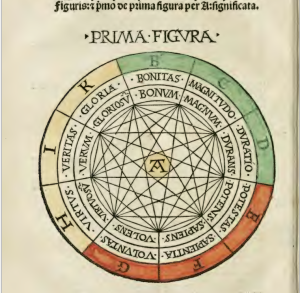
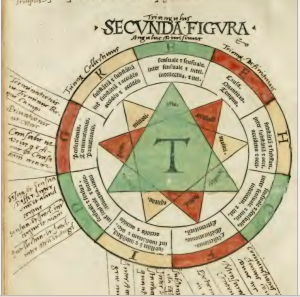
Raymundus Lullius – ARS MAGNA